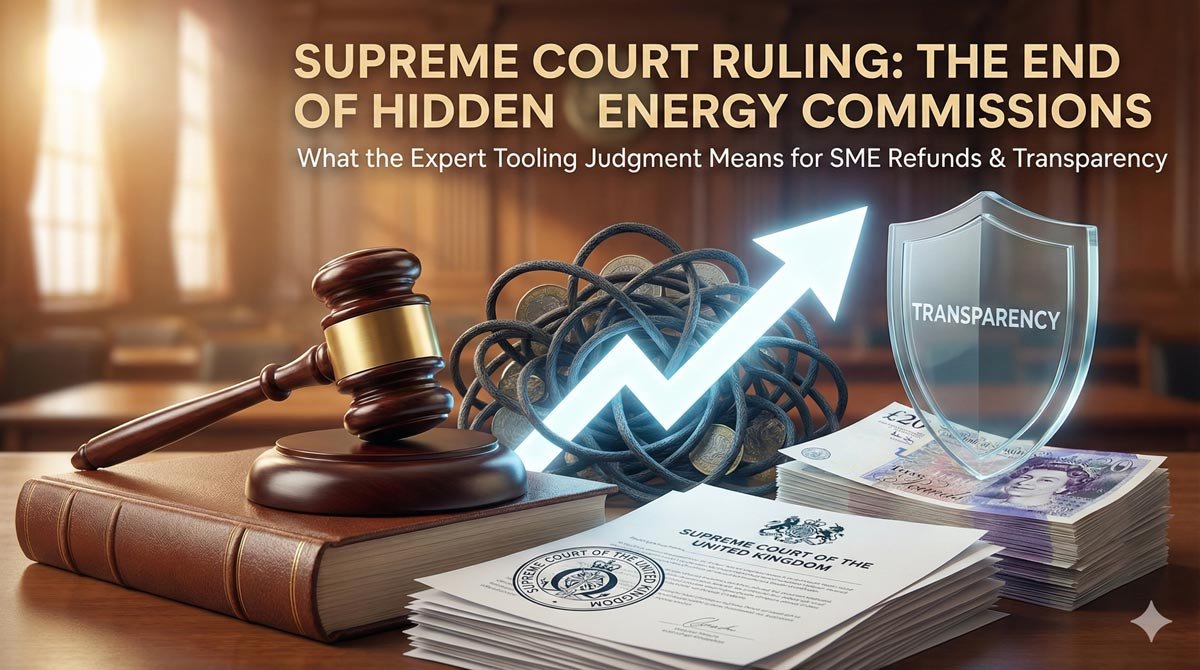
In a landmark decision that will send shockwaves through the UK energy market, the Supreme Court has ruled decisively against the practice of “secret” and “half-secret” broker commissions.
For years, we at EnerBiz have campaigned for total clarity in energy billing. We believe that you cannot make the right choice for your business if the costs are hidden. This week, the highest court in the land agreed with us.
Here is the “meat” of the ruling, the case details, and—most importantly—what this means for your business’s bank balance.
The Legal Breakthrough: Expert Tooling & Hopcraft
Two major cases have converged to change the law: Hopcraft v Close Brothers Ltd and the subsequent ruling in Expert Tooling and Automation Limited v Engie Power Limited.
What Changed?
Historically, many energy brokers operated in a “half-secret” grey area. They would tell you, “We may be paid a commission,” but they wouldn’t tell you how much it was, or that it was hidden inside your unit rate (p/kWh).
Suppliers and brokers often argued that this vague disclosure was enough. The Supreme Court has now ruled that it is not.
The Court confirmed that if a broker owes a “fiduciary duty” (a duty of trust) to their client, they must obtain fully informed consent. This means they must disclose:
- The existence of the commission.
- The exact amount being paid.
- How it is calculated (e.g., added to your unit rate).
If they failed to do this, the commission is considered a “bribe” or “secret profit,” and the business is entitled to claim it back.
Why This Matters for SMEs
This ruling is a massive victory for Small and Medium Enterprises (SMEs), who have historically been the hardest hit by these hidden uplifts.
1. You Could Be Owed Thousands
If you used an energy broker in the last few years (excluding your current EnerBiz contract), and they did not explicitly tell you the exact value of their commission in pounds and pence, that contract may now be legally challengeable.
- The Impact: SMEs can potentially reclaim 100% of these hidden commissions from past suppliers.
- The Scale: For a manufacturing SME or a business with high consumption, these hidden fees often amounted to tens of thousands of pounds over a 3-year contract.
2. The “Unit Rate” Illusion is Shattered
This ruling exposes why some “cheaper” quotes weren’t actually cheaper. Unscrupulous brokers often inflated the unit rate to hide their fee.
- Example: You were quoted 35p/kWh.
- Reality: The energy cost was 32p/kWh, and 3p was the broker’s hidden fee.
- Now, you have the legal right to know that breakdown before you sign.
The EnerBiz Transparency Promise
This legal update brings the rest of the industry in line with what EnerBiz has always practiced.
We have always separated “energy costs” from “non-energy costs” because we believe transparency builds trust. When we present a proposal, we don’t hide our service fees in a murky unit rate.
Our Transparency Approach:
- Clear Line Items: We break down the costs so you see exactly what goes to the generator, the grid (TNUoS/DUoS), and to us.
- Informed Choice: You know exactly what you are paying for our expertise.
The Supreme Court ruling vindicates this approach. It proves that the “old way” of doing business—where brokers treated your bill as a place to hide extra revenue—is not just unethical; it is now legally indefensible.
Action Plan: What Should You Do Now?
1. Audit Your Past Contracts Look at your previous energy contracts (from other providers). Did the broker state exactly how much they were earning? If not, you may have a valid claim for reimbursement.
- Tip: Check the T&Cs for vague phrases like “we may receive a commission.” As per the new ruling, this is likely insufficient.
2. Demand “Fully Informed Consent” Moving Forward Never sign a new energy contract unless the broker/TPI (Third Party Intermediary) discloses their full fee in writing.
3. Stick with Transparency At EnerBiz, we are already compliant with these high standards. If you are worried about hidden costs in your current procurement strategy, talk to us. We will show you the true cost of your energy, with nothing to hide.